
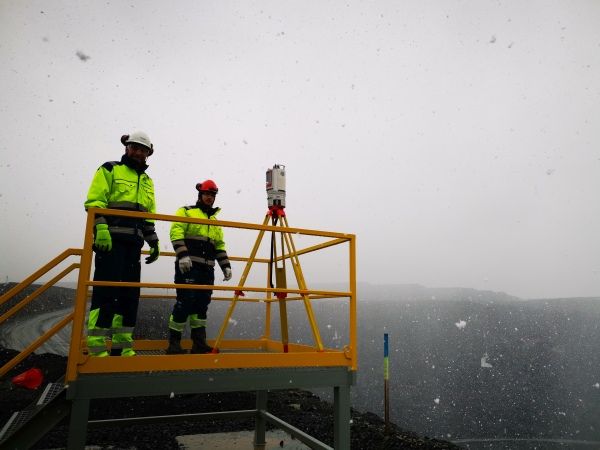
Safety and efficiency in demanding conditions
Mining operations operate in environments where conditions are constantly changing. Efficiency and safety depend on the ability to monitor these changes in real time. Laser scanning (LiDAR) has established itself as a critical tool in both open pit and underground mines, providing accurate and reliable data for mining planning and structural stability monitoring.
In the mining industry, laser scanning is not just a measurement tool, but an essential part of risk management and operational excellence. It provides visibility where conditions are most challenging and ensures that production continues uninterrupted and safely.
What is laser scanning used for in mines?
Laser scanning applications cover the entire mine life cycle from exploration to closure:
- Open pit mines and tunnels: determining the directions of the rock face
- Open pit mines and tunnels Continuous monitoring of the stability of rock walls and tailings ponds to anticipate potential collapses.
- Open pit mines and tunnels: inspection of geometry, profiles and loose stones without the need to take personnel into hazardous areas.
- Warehouse pile analyses: Fast and accurate calculation of material levels and volumes in concentrators and warehouses.
- Infrastructure inspection: Monitoring the condition of conveyor belts, shafts and other structures to minimize wear.
How does laser scanning help mining professionals?
High-performance scanners like Riegl are designed to withstand dust, vibration and extreme temperatures, providing the following benefits:
1. Maximizing occupational safety In a mining environment, safety is paramount. Laser scanning allows hazardous areas, such as high walls or newly blasted tunnels, to be measured from a safe distance. As a carrier platform for robots or drones, a laser scanner can explore places that humans cannot go.
2. Real-time monitoring and alerts Continuously scanning systems detect even the slightest changes in the stability of rock walls. Automatic analyses can provide immediate alerts if movement is detected, allowing the area to be evacuated before a potential collapse occurs.
3. Accurate monitoring of extraction volumes Traditional measurement methods are slow and often contain margins of error. Laser scanning instantly provides accurate volumetric information about mined ore or waste rock. This streamlines logistics and improves financial reporting.
4. Optimized tunnel profile tracking In underground mining, it is important that tunnels follow the planned geometry. Scanning immediately reveals ”under- or over-excavation”, saving costs in both reinforcement materials and transportation.
5. Digital twin to support decision-making A point cloud covering the entire mine forms a digital twin where all data is up-to-date. This facilitates production planning, ventilation optimization and rescue plans.